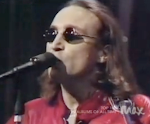
Imagine - John Lennon (live)
Imagine Live - John Lennon - '72


 Absolutely wonderful movie
 . . music by The Beatles . . . sung by other wonderful musicians
An original musical film, watch it here and here - Across The Universe, is a fictional love story set in the 1960s amid the turbulent years of anti-war protest, the struggle for free speech and civil rights, mind exploration and rock and roll. At once gritty, whimsical and highly theatrical, the story moves from high schools and universities in Massachusetts, Princeton and Ohio to the Lower East Side of Manhattan, the Detroit riots, Vietnam and the dockyards of Liverpool. A combination of live action and animation, the film is paired with many songs by The Beatles that defined the time . . .
More on The Beatles


Cary Grant plays Earnest Bliss a rich socialite, who inherits his fortune, and makes a bet with his therapist that he can make a living for one year using none of his current wealth. Filmed in London.
It's a tiny screen, but it IS Cary Grant!
Artist Name: Bob Marley
Artist Bio:
There's no denying that Bob Marley remains the best-known name in reggae, even more than 20 years after his death. But think for a second about why he's known—the picture with the giant spliff and dreadlocks, and a few songs like "One Love," "Three Little Birds," "Jamming" and, of course, "I Shot The Sheriff". That's only one part of who Marley really was.
It ignores his real revolutionary stance and spirit, which is what helped make him such an icon to most of the non-Western world. . .
Even before most of the world had heard of them, they were already major stars who'd gone through some serious musical growth, from the lovely "Stir It Up" through the more politically aware "Simmer Down," a song aimed at curbing the riots of 1966, to the quantum leap of sound once they joined up with producer Lee Perry and his house band. . . 
. . .With "Them Belly Full (But We Hungry)," "Rebel Music (3 O'Clock Roadblock)" and "Revolution" he laid down his manifesto—and it wasn't all peace and love, but social justice. . . If he was a hero to many, at home he attained almost godlike status. He was perhaps the only man in Jamaica who could bring peace in the December 1976 general election, and that was what he tried to do. The night before his peace concert, however, he was the victim of an assassination attempt. The next day, his arm in his sling, he still appeared onstage before leaving Jamaica for a year.
Although he released two lovely discs beforehand, it would be 1979 before Marley made his most explicit public statement with Survival. "Africa Unite" and "Zimbabwe" showed he was thinking internationally, something few artists did, and the album was, at heart, a call to arms for Africa. He followed it in 1980 with a tour of Africa that cemented his legendary status there, and with Uprising, whose closing "Redemption Song" is still about a wonderful an epitaph as a man can hope to have.